Saturday, April 14, 2012

Animal Behavior College Mentoring


I have the pleasure to help aspiring dog trainers studying with ABC begin to make their dreams a reality by guiding them through the 18 week hands on program as their trainer, mentor and friend. These 18 weeks include 6 weeks of observing my classes, 6 weeks of training a dog of their own in my classes and finally 6 weeks of student teaching. I am fortunate that the students who come to me arrive with open minds and enthusiasm to learn and grow their understanding of animal behavior, teaching and handling skills. I have been very pleased with their willingness to embrace the power of positive reinforcement with training animals and am proud to say all of my students completing the 18 week program under my wing have graduated! Even if they are still on their journey to success I feel great to have made a difference in each and every one. Below is a most recent note from one of my students Liz.

"Sarah- I just wanted to shoot you an email to let you know I graduated today! I am so grateful to have had you as my 'mentor', I learned so much invaluable information from you. Thank you so much for your time and your great teaching. Without your mad clicker skills I would have never fully understood the importance of clicker training. Thank you again!" - Liz Buchanon

Sunday, February 26, 2012

Amy and Ramona

Always nice to share great clients' great comments about their positive experiences with positive reinforcement!

Amy Chase & "Ramona"
A few months after bringing home Ramona, our adorable and sweet Golden Retriever puppy, I began to have concerns regarding her interactions with my three children, ages 11, 9, and 2. We have had the heartbreaking experience of unknowingly adopting dogs who had extreme fear based aggression, and because of this I was a bit uncertain about what might be normal puppy behavior. Ramona was extremely mouthy, vocal, and tended to chase the children and pounce on them even while they sat calmly on the couch. We desperately wanted to raise a happy, confident, well behaved dog. All my friends with dogs recommended techniques that would force submission and compliance, none of which I felt comfortable with, knowing my goals would definitely not be realized. I did not want to damage our fragile human/canine bond in any way and the methods suggested to me would have only ensured that result. Luckily for all of us, I found Sarah’s card at my vet’s office. Since meeting and working with Sarah, both at her puppy classes and at home with her private lessons, I have been amazed at how well positive reinforcement and clicker training works with Ramona. I am more confident with her interactions with our children, especially the toddler. Ramona is more confident too, and LOVES to train. We still have issues to work on, but I am so grateful to Sarah and Whole Dog Training for teaching not only Ramona, but my family as well. We now have a better understanding of canine behavior and have the necessary tools to reach our goals. Sarah is simply amazing, you can tell she really loves her profession and as a result dogs happily respond to her. We love training with Sarah so much we plan to attend her Puppy Level 1 class at a future date!

Monday, August 1, 2011

Sarah on Fox 5 News talking about positive training

I had the chance to do two segments on Fox 5 news today.


Here is the first one- a brief discussion on the beginnings of keeping dogs and babies safe and training what you want- good habits- from the get go!

http://www.fox5sandiego.com/videobeta/62a9f1e1-2967-44b7-8264-f7ab3902ae65/Community/Dogs-and-Babies

Here is the second one- on Making Training fun!

http://www.fox5sandiego.com/videobeta/e653734a-3282-4206-8e0f-c4b9f8c8eaaf/News/Make-Dog-Training-Fun

Wednesday, February 2, 2011

My Submission to the Canis Film Festival!

The final videos are in! Here's mine: Horsin' Around. I spent a lot of time putting it together and can't wait for the release of Horsin' Around Part II!!

http://www.video.clickertraining.com/canis/11_final_08

I hope you enjoy it as much as I did creating it!

Wags n Whinnies

Sarah

Sunday, January 9, 2011

Paying it forward with puppy love....


Just finished teaching my puppy classes this week and had the pleasure of working with the new adopters of Sunny and Cher. Here's a photo of the two 11 week old Lab mix puppies who were found back in the fall with their ears cut off. They are actually focused and giving me attention (that's my knee!) as I reward them for calm sits and eye focus.

Both puppies will be starting off on the right paw (as well as their owners) with clicker training and attending my Saturday puppy class in Encinitas. The puppies are little love-bugs! Of course everyone will recognize them with their unique look so it's important to give them the tools to be successful out there in the world; A trusting relationship with their owners and socialization to the world around them all supported with positive reinforcement will give them the stepping stones to great success. I am looking forward to being a part of their growth!

Puppies_2_t352.jpg

Click the link here for the adoption story from January 4th.

Friday, October 8, 2010

Is YOUR dog a Canine Good Citizen?

We all set goals to obtain for ourselves, why not our pups!? Try out these test items with your dog. If you really want to work for it we offer sessions and a CGC training class (coming soon at www.wholedogtraining.com) to prep you and your furry friend for passing. The AKC will award you and your pup with a Certification and all sorts of items to show off your dog's new manners and accomplishments! There is even a course for puppies and we will be offering STAR Puppy classes at our new training facility too! Stay on top and check out our new digs on Oct 30th from 2-5pm in Scripps Ranch. I am a CGC Evaluator and would love to help you reach your goals! Below are the 10 test items highlighted.

banner.jpg


(see www.akc.org for detailed test information)
Test 1: Accepting a friendly stranger
This test demonstrates that the dog will allow a friendly stranger to approach it and speak to the handler in a natural, everyday situation.

Test 2: Sitting politely for petting
This test demonstrates that the dog will allow a friendly stranger to touch it while it is out with its handler. With the dog sitting at the handler's side, to begin the exercise, the evaluator pets the dog on the head and body.


Test 3: Appearance and grooming
This practical test demonstrates that the dog will welcome being groomed and examined and will permit someone, such as a veterinarian, groomer or friend of the owner, to do so. It also demonstrates the owner's care, concern and sense of responsibility.

Test 4: Out for a walk (walking on a loose lead)
This test demonstrates that the handler is in control of the dog. The dog may be on either side of the handler. The dog's position should leave no doubt that the dog is attentive to the handler and is responding to the handler's movements and changes of direction.

Test 5: Walking through a crowd
This test demonstrates that the dog can move about politely in pedestrian traffic and is under control in public places. The dog and handler walk around and pass close to several people (at least three).

Test 6: Sit and down on cue and Staying in place
This test demonstrates that the dog has training, will respond to the handler's cues to sit and down and will remain in the place cued by the handler (sit or down position, whichever the handler prefers). The dog must do sit AND down on cue, then the owner chooses the position for leaving the dog in the stay. Prior to this test, the dog's leash is replaced with a line 20 feet long.

Test 7: Coming when called
This test demonstrates that the dog will come when called by the handler. The handler will walk 10 feet from the dog, turn to face the dog, and call the dog. The handler may use encouragement to get the dog to come. Handlers may choose to tell dogs to "stay" or "wait" or they may simply walk away, giving no instructions to the dog.

Test 8: Reaction to another dog
This test demonstrates that the dog can behave politely around other dogs. Two handlers and their dogs approach each other from a distance of about 20 feet, stop, shake hands and exchange pleasantries, and continue on for about 10 feet. The dogs should show no more than casual interest in each other. Neither dog should go to the other dog or its handler.

Test 9: Reaction to distraction
This test demonstrates that the dog is confident at all times when faced with common distracting situations. The evaluator will select and present two distractions. Examples of distractions include dropping a chair, rolling a crate dolly past the dog, having a jogger run in front of the dog, or dropping a crutch or cane.

Test 10: Supervised separation
This test demonstrates that a dog can be left with a trusted person, if necessary, and will maintain training and good manners. Evaluators are encouraged to say something like, "Would you like me to watch your dog?" and then take hold of the dog's leash. The owner will go out of sight for three minutes. The dog does not have to stay in position but should not continually bark, whine, or pace unnecessarily, or show anything stronger than mild agitation or nervousness.

Saturday, August 28, 2010

Product review!

I recently came across the Dog Brick, a fun interactive food dispensary game for my dog and clients. The Dog Brick, distributed by Company of Animals (www.companyofanimals.com), is an easy to learn game for dogs of all ages and sizes. The concept is simple! Fill the hidden slots with your dog’s kibble and slide the covers over it. The center section can also be filled with additional treats and kibble which are then covered with four plastic dog bones. The dog quickly learns to remove the middle section bones and slide the outer covers to reach the hidden slots. Some use their mouth, some their paws. For small dogs, like mine, it holds his complete meal.


The game offers wonderful mental stimulation for the dog and proves to be entertaining for them! For dogs who need something to do when you leave the house this is a great choice. The bones and sliding sections of the toy work well and there are minimal pieces to clean and pick up.


This is a great interactive food game for dogs and children. Children can be a part of helping to feed the dog by filling the slots and hiding the treats in each section. They can easily carry the tray over and watch without having to encroach into the dog’s space- this keeps it fun and safe for everyone playing! I have two young children and we’ve all enjoyed watching Bosley enjoy his meal time! Not only does Bosley enjoy eating his kibble out of it each morning but my 3 1/2 year old James enjoys being a part of feeding time more so now than he did when it was just a scoop of kibble here and there into a bowl.


Remember, your dog learned how to eat their meal out of a bowl long ago. Practice offering them more ways to earn their meals. Stimulate them!


Sunday, June 13, 2010

Explore on all fours!! Summertime Safety and Fun!


Whether you choose to visit the beach, desert or mountains there is a vast selection of pet-friendly places in San Diego. For a nice breakfast with your pooch visit St. Germain’s Cafe in Encinitas (www.stgermainscafe.com) . They also offer a festive Yappy Hour on Friday and Saturdays through the summer months. Fiesta island and Del Mar offer dog friendly beach areas. Leash laws at Del Mar dog beaches vary throughout the year so be sure to read the signs. If you feel like grabbing some pizza and a micro brew after a long hike or jog along the boardwalk swing by Pizza Port in Carlsbad (www.pizzaport.com ) to enjoy their dog-friendly patio. Rancho Coastal Humane Society in Encinitas has Cricket’s Corner, a quaint dog park attached to their grounds. Dexter’s Deli (www.dextersdeli.com) sells all the supplies you’ll need for your adventure and welcomes dogs of all sizes to shop with you. One of my favorite areas to walk is along the San Elijo Lagoon in Solana Beach (www.sanelijo.org/trails.html). There are more than 7 miles of trails available. Out east is another great spot: Mission Trails Regional Park. Cuyamaca Rancho State Park allows dogs on their trails as well as camping and fishing.


Once you decide on your destination, be sure to always plan for the unexpected. There are always a few things to keep in mind. The morning may start off foggy and cool but San Diego often warms up quickly. Always be prepared. First remember to bring water for both you and your dog. I prefer the collapsible bowls since they are easy to carry. You can purchase one at any local pet store. Water will help prevent overheating.


Remember! Dogs don’t sweat. We may have plenty of ways to cool our bodies down on a hot day however dogs rely on just two. Their skin and armpits don’t contain sweat glands like ours do. They perspire through their paw pads. Their main way to cool down, however, is by panting. Since they have fewer ways to release heat from their bodies it becomes more important for us to pay attention to the potential of heat stroke.


HEAT EXHAUSTION AND HEAT STROKE SYMPTOMS:

  • Hot skin
  • Salivation
  • Exaggerated panting
  • Sudden stop of panting
  • Rapid or erratic pulse
  • Anxious or dazed, staring expression
  • Weakness
  • Twitching muscles
  • Lack of coordination
  • Blue or red tongue / lips
  • Vomiting
  • Convulsions or Collapse

EMERGENCY TREATMENT

  • Move to a cool, shady place
  • Wet dog with cool, not icy water
  • Leave airways unobstructed
  • Do not apply ice
  • Fan vigorously to promote evaporation
  • Allow cool water, ice cream

URGENT - TAKE DOG IMMEDIATELY TO A VETERINARIAN FOR TREATMENT.


There are several ways to help your dog avoid over-heating during these hot summer months. Be alert to your dog’s excessive panting when it’s combined with high temperatures and excessive exercise. Recognize how far his tongue hangs out during your workout. Be sure to take several mini breaks if you notice his tongue hanging more than halfway out of his mouth as this can be a beginning sign of over exertion. Don’t forget to stay hydrated.


Temperatures on pavement can rise up to 150 degrees which can be quite painful on the paw pads. Would you walk barefoot on 150 degree blacktop? If you answered no, your dog would probably say the same if he could speak! Recognize whether or not your dog begins to pick up his paws more quickly as it can be a sign that the footing has become too hot. Consider purchasing paw protectors for your dog in case the ground gets too hot or is covered with burrs or foxtails. Help prevent your dog’s paws from possibly getting sore, cut or burned. Lastly, plan your excursions, walks and hikes during the early morning hours or just prior to sunset when the temperatures are lower.


When you choose hiking be sure you read all signs before entering the trail. Some national and state parks don’t permit dogs. Always keep a leash with you and ideally hooked to your dog. Even if you believe your dog is reliable off leash a leash is the tool you will need to prevent your dog from chasing wildlife, other dogs, hikers etc. Remember in San Diego county there is a leash law. If you walk or otherwise bring a dog to public or other private property (where dogs are permitted), you must restrain the dog by a hand held leash (not longer than 6 feet in length) (SDCC Sections 62.669[a], 62.601[d], and 62.601[y]), unless otherwise specified by signs. Retractable leashes are considered to be longer than 6 feet even if they are set to 6 feet or less. You will be subject to ticketing and fines for using one, in addition to being caught breaking the above county code sections. Don’t assume just because your dog is safe off-leash that all other dogs and owners will be too!


Please be a responsible dog owner and pick up after your dogs. Not all dog parks, beaches and trails have doggy bag dispensers. If they do, don’t count on them being stocked. Whatever you decide to do, have fun and make it enjoyable for your dog! Any excursion you take your dog on is a great opportunity to train. Take note when they recognize a new distraction or object and praise them with a scooby-snack or a good dog! They’ll need a chance to take in a snack just as you will and working on some behaviors you like as others pass by you is a great opportunity to train and treat. Have fun and keep it pawsitive!


Tuesday, May 25, 2010

Horse Recall- reinforced with the clicker!


Madeline and I had a great time playing with Chrissy yesterday at the barn.
We practiced some recalls and I have to say I love how reliable Chrissy's recall has become.
I use her name for my orienting sound generally to get her attention and my whistle to recall her. This particular video I had already put away my clicker and treats for the day but this behavior for Chrissy is pretty reliable now. Notice how Madeline is at the other end of the arena and calls Chrissy back to her! Chrissy has fun with this game.


Sunday, April 25, 2010

Reliable Recalls

Here's a quick video of Bosley coming when called quite reliably when he least expected it. He retreated to relax in the shade under a tree only to remember how FUN it is to come running to me when called!!

Don't forget!- Your recalls need to be well trained in low distracting environments first to build the foundation of the behavior linked with the desired cue. Is your dog's tail wagging when they get to you!? It should be fun for them to WANT to come to you!


Wednesday, September 9, 2009

Cesar's Way- definitely NOT a Whisper. Book Review!

Book Review: Cesar’s Way, by Cesar Millan.

Cesar’s Way: Definitely NOT a Whisper

By Kathy Meyer, VMD

Although the jacket claims that the book offers a “natural, everyday guide to

understanding & correcting common dog problems,” Cesar’s Way, by Cesar Millan (aka

the Dog Whisperer) delivers very little usable information for dog owners. The book is

aptly named, as its main focus is Cesar, not the dogs. Instead of providing revolutionary

insight into dog psyche, Cesar’s Way largely describes Cesar’s own interpretation of

various problem dog behaviors and his methods of treating. The typical dog owner can’t

use these methods, as they involve 4 or 5 hours of vigorous exercise a day, time with a

pack of 40 to 50 dogs, and physical corrections and intimidation to achieve submission.

Cesar’s various and sometimes peculiar philosophies and beliefs are woven throughout

the book, making it more a treatise on his views of how dogs and owners (and even men

and women) should construct their relationships rather than a useful guidebook to

promote a harmonious life for dog and owner.

The most glaring faults of the book are not so much what is included, but what is not.

First, there is no acknowledgement of the dog’s ability to quickly and easily learn dozens

of words to create a common vocabulary between dog and owner. This is otherwise

known as training…something that has been very helpful over the thousands of years of

human/dog interactions. Communication in this way has allowed dogs to be trained for

very complex, useful behaviors in their complex lives as 21st century pets in a developed

country. Cesar, however, strives for a “primal” relationship between dogs and their

owners, epitomized in his view by homeless people and their dogs. In this primitive

construct, Cesar uses no words to communicate with his dogs. Instead, the only sound he

will issue is a harsh hiss, which will generally cause dogs to display submission when he

is displeased. So, instead of teaching a dog to sit or down/stay and then asking the dog to

remain calm so it can “earn” its dinner, Cesar expects the dog to just “figure it out,”

regardless of how confused, hungry, and frustrated the dog becomes. Likewise, the poor

fearful dogs Cesar “rehabilitates” could be easily taught to sit and stay while desensitized

to his approach rather than being subjected to forceful, terrifying intimidation tactics

described in the book. Cesar states that he will repeat these techniques “a thousand

times” if necessary with fearful dogs.

Also related to training, or lack thereof, is Cesar’s method of “discipline.” The book

doesn’t specifically advise owners on how to stop their dogs from doing what Cesar feels

should be forbidden. Other than taking the dog on long marches on the end of a short

lead with a noose around the most sensitive area of the neck and projecting calm,

assertive energy, the reader is at a loss as to how he or she is to change her dog’s

behavior. Based on his “Dog Whisperer Show,” the method of discipline appears to

involve punishment delivered verbally (his “hiss”) or through tightening of the choke

collar to the point of shutting off the airway. Cesar does discuss the “alpha roll,” in his

book, but wisely cautions owners from doing it on their own dogs except under the

guidance of a trained professional. I suspect the advantage to this is that the trainer will

end up in the emergency room rather than the owner. The purpose of discipline is to

educate the dog, and the approaches alluded to in this book do not instruct the owner to

show the dog what the owner would like him or her to do instead of the undesirable

behavior.

In addition to the above-mentioned omissions, there are no recommendations made for

simple environmental manipulations that could minimize or even solve many problems.

For example, Cesar mentioned a dog that bit mail carriers to the point that the USPS

would not deliver mail for the entire neighborhood. This case was featured on a Dog

Whisperer episode, which I did review. Not once did Cesar advise the owner to keep her

dog under control by not allowing it to run at large, unsupervised, in the neighborhood.

Although Cesar’s appearance dressed up in a postal uniform was perfect TV schmaltz,

it’s unlikely this one-time encounter will affect that dog’s future behavior toward the real

mail carriers. Another case described in the book involved a dog that walked in perfect

submission, unleashed down a city street to its owner’s photography studio. However, at

the studio, the dog began to display aggression toward clients. Cesar dramatically

described the horrible outcomes, including euthanasia, if this behavior could not be

stopped! However, he did not mention simply leaving the dog at home or using a leash,

gate, or crate at the studio until adequate training could be achieved. More to the point,

he didn’t even describe how the owner was to stop behavior. Cesar simply advised him

to act like a leader. Sadly, Cesar not only missed opportunities to easily direct the reader

to successful strategies, but glamorized the walking of a dog off-lead in a busy city,

which is unlawful in many jurisdictions and could prove fatal for a dog.

While Cesar’s opening autobiography in the book provides a touching “rags to riches”

story, it is of no particular help to the dog owner. However, it does provide great insight

into Cesar’s perception of the perfect life for a dog. His ideas were clearly formed during

his childhood, where he observed the behavior his grandfather’s nearly feral farm dogs.

The dogs lived outdoors, were not regularly fed, and received no health care, save hosing

for severe infestation of external parasites. The dogs were not trained, but just

“naturally” knew what to do. This construct of the perfect life for a dog reappears later in

the book, when Cesar declares that the happiest dogs in America are those owned by

homeless people, as they engage in the proper following behavior required of all dogs if

they view their owners as “dominant”.

As Cesar goes on to describe various types of aggression he treats, he uses terms such as

“unbalanced” and “negative energy.” These vague terms do little to help advance our

understanding or aid owners in preventing or treating problems. His rehabilitation

techniques, while interesting, are simply descriptions of what he, himself, does at his

facility. In general, it involves heavy exercise to induce a “calm, submissive state,”

exposure to the pack of dogs, and a feeding process where only the calmest dogs are

given their food. As previously noted, these techniques do not easily transfer to the

typical dog owner.

Throughout the book, much is made of popular “dominance theory” and its application to

dog training. Cesar maintains that a dog that jumps up during greeting, pulls on a leash,

or walks through the door first is dominating the owner. These assertions are patently

false. Many dogs jump during greeting while displaying obvious submissive behaviors.

They are whining and licking! The reason they jump is to sniff the owner’s face, which

is simply vertically oriented rather than horizontally oriented, like other dogs. Likewise,

pulling on the lead or going through the door first usually relates to a simple lack of

training and the dog’s ability to move much faster than its human companion. Cesar’s

description of wolf pack behavior is not supported by the latest research. There is no

constant scrabbling to be top wolf. The pack structure is simply a family, with mother

and father at the top and several years’ worth of maturing offspring. Placement in the

hierarchy is based on sex and age.

In the final section of the book, Cesar offers up the closest thing to advice for owners in

the book. I do agree with many of his questions prospective owners should ask

themselves prior to taking on a puppy. However, while I agree exercise is important, his

recommendations for exercise in excess of 1.5 hours of walking per day, are not practical

for most people. I am particularly concerned about the potential for injuries to dogs

worked out on the treadmill, and joint damage to dogs under the age of two who may be

asked to wear a backpack full of filled water bottles, as he suggests. Under the discipline

section, Cesar repeatedly will advise owners what not to let their dogs do, such as wake

them up in the morning or greet them too enthusiastically upon their return. As noted

above, he doesn’t tell owners how to stop the behavior or what alternate behavior the dog

should be taught! The most concrete advice I could find was for owners to always

behave in a calm assertive way. I do endorse this concept but it would be much more

helpful for Cesar to instruct readers on exactly what they should do with the dog while

being calm and assertive.

“Cesar’s Way” will make a fine read for you if you want to learn about Cesar and how he

claims to dramatically rehabilitates dogs to live in his pack. His is an impressive story of

human ambition and resolve, which makes a nice marketing package for simplistic,

outdated, and sometimes downright dangerous techniques. However, if you are a dog

owner looking to deepen your relationship with your dog and/or improve your dog’s

behavior, I would direct you to authors such as Patricia McConnell, Jean Donaldson, Ian

Dunbar, and Sophia Yin. By using more advanced, humane techniques of true dog

training, you will surely improve the quality of life for both you and your dog. And the

book won’t be centered on the messenger; it will be centered on the message.

Wednesday, August 19, 2009

Thursday, August 13, 2009

every little bit helps.... I hope!

So I just had to share an experience I had today.... mainly because I suppose it seems to happen quite often in "dog-land" and it just FRUSTRATES the heck out of me. It's when I see an unleashed dog racing over to me and my dog (on leash) or even a dog "released" to approach on a retractable leash (another story in itself).....so today I happened to say something. I hope the few words I spoke possibly sunk in and made some sort of an impact to the dog's owners....but I'm can't be positive since they were young teenage kids and I really didn't explain the benefits of my comments to the dog's owners. I can hope though. :)

So I was walking my sons in the big double BOB stroller and on leash alongside us walked Bosley, our 10 lb terrier. We cut through this one parking lot which dumps us out onto the street we need to get to.... you know, a simple short cut. As we approach the street and prepare to come down the side walk and enter the cul-de-sac area I see two boys (I'm guessing 11 and 17?) playing ball with their large lab/sheppard mix of a dog. Pretty large dog, 80lbs or so. Bosley perks up of course and I click/treat click/treat. He's always so good when passing other dogs. Well this dog was off leash. Here's the thing- I know MY dog is good- but you just NEVER know about the other dog, do you?! This is why there is a leash law..... and even if they say THEIR dog is "good", how do they know my dog isn't!?

We continue to walk by and their dog comes quickly up to Bosley's rear and sniffs. "Let's go" I say as we walk on without any hesitation. The boys meanwhile, are just standing there yelling at the dog to return to their side "come here, hey , -dog's name- , hey, hey, come here". The boys don't move a step. They continue to yell. CLEARLY the dog is highly distracted by my adorable terrier and wants nothing of the sort to return. We keep walking - but slowly enough so that if they wanted to they could grab their dog. I am keeping an eye on the behaviors the large dog is offering and things appear "fine". The boys still haven't moved. Again, the reason I write this today is because I finally said what I always WANT to say on my walks to others- EEK- but never do. I was very "courteous" when doing so- I said " Perhaps you should just come and get your dog vs just yelling at him." And......... what did they do? Just exactly that. Uh, yeah, duh! That dog would have joined me for my 3 mile walk had I not said anything! Okay, well at least for another few houses!

Too often do we just sit back and command! Especially when the dog is clearly overly stimulated to be "hearing" you in the first place. In addition, many people get far too confident with their unleashed dogs. It's just not worth taking the risk safety-wise nor fun for the dog if all he gets is what happened today- yelling, yelling and more yelling and then a big jerk on the collar and yanked back to their ball session.

The positive out of this is that my dog gave me all the attention I needed while walking past that incident. He knew that coming with me was going to earn him a nice reward. I hope those boys started to see a lightbulb at least BEGIN to turn on!

Monday, August 3, 2009

Clicker training other species!

Try it with your dog, your cat, your bird or your horse! Here Chrissy has learned to relax and settle as a result of positive training with the clicker. She has learned that this choice of hers gets her yummy rewards! With training, it's important to always give your animals opportunities to make their own choices- reward those you want to see again! Chrissy knows this behavior pays off!
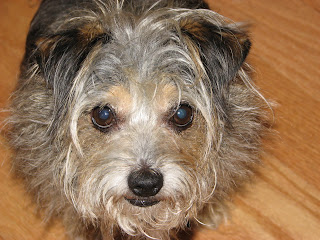
I've always wanted a big dog!! I wouldn't however trade my 10 lb terrier mix Bosley for the world!

Tuesday, July 28, 2009

MY dog is smart!

Well I already KNEW Bosley was smart... but you know, sometimes being a dog trainer, you get so busy training OTHER dogs that you don't spend AS much time training with your own dog. Today the Boz-man and I worked on a bunch of targeting and shaping behaviors. He has always been great on the matt but today he chose (after working a few minutes on it) the large carpet, that is a recent addition to our family room, as his default matt. What a great idea! I just love watching dogs Think and learn and while doing so saying: "this mom? is this it? does this work?" He would skip right on over like an excited 2 year old in a candy shop and pounce on the carpet section waiting for the next request. What a cute little guy. I'm motivated to do even more with my dear little friend. :)

Our companions are SO willing to please. Don't forget to give them the opportunities!

Friday, July 3, 2009

4th of July and Summer Safety!

It's that time of year dog owners! The June gloom is behind us and Summer is here! I know because I got a pretty bad sunburn this past weekend and my back is peeling!

What does this mean for your dogs? It means you need to pay a bit more attention to them.

Make sure you NEVER leave them in the car. Not even with the windows down! Think ahead. If you must take them but can't take them in to where you are headed then go on that errand at another time! The car's temperature inside increases FAST and it gets extremely hot inside. ** you should never leave your dog in the car anyways!**

Make sure you always bring extra water for your dog! I went on a walk yesterday and made sure I shared my water with my dog. He's working too! And it's Hot outside! It's very important to keep the animals hydrated, as it is yourself. You can buy portable water bowls and even portable dog water bottles with a bowl attached!

Pay attention to how hot the payment is. Some dogs may burn their paw pads. If you're planning a noon-day walk, perhaps reschedule until early evening when the pavement is a bit cooler.

Some fair skinned dogs or light muzzled dogs may burn easily too. Check with your Vet for the best SPF skin protectant..

With fire works - the BEST solution is to leave your dog at home. Even a CD with calm music to cover up the loud noises going on outside helps too. You can look into purchasing calming collars which have a great effect as well.

Keep in mind dog's senses- especially hearing! are far superior than ours. So it should be no surprise that the fireworks would be a bit frightening to them. The idea of watching a firework show and having a picnic just isn't their cup of tea!! Do what's best for THEM....keep them at home and try not to go walking at the time fireworks may be going on.

Friday, June 19, 2009

Are you a Cesar Millan Fan? I hope not!

Finally more and more are realizing that Cesar's methods are not the most ideal methods to train dogs with. Finally...people are taking action. Below is the pdf of the letter from the American Veterinary Society of Animal Behavior to Merial who is considering promoting Cesar's and his methods in a Heartgard and Frontline campaign:

(copy and paste the following in your browser)

http://www.avsabonline.org/avsabonline/images/stories/Current_Events/merialletter6-10.pdf

They even have references to speak about the results of Cesar's training. "We would also be happy to provide you with additional peer-reviewed references indicating that the training methods televised on “The Dog Whisperer”often lead to increased aggression and human injury. " I think viewers forget this is ALSO a television show where editing is used aggressively.

I hope that you continue to use positive reinforcement with your dogs.....

Come on now! and GET Pawsitive! :)

The pioneer of clicker training

Karen Pryor has a new book out! I definitely recommend you read it. Check out her recent showing on ABC to hear and see a nice quick overview of just what it means to click!
link:


http://abcnews.go.com/video/playerIndex?id=7850537

She just needs a little more time to train the newscaster on the rules of the click--- click/treat click/treat ... :)

Thursday, April 2, 2009

Recalls?

It's been a bit since I've posted- busy with trying to buy a house, being pregnant and well- then there's work! :)

But how about recalls!? We all want our dogs to come running to us when we call them, right? But what's most important is that the "come" cue is RELIABLE when we LEAST expect we are going to NEED our pup to come running to us!! (ie: someone left the front door open-oops! and there went the doggie!)

SO what does this mean?? This means- try to practice getting the dog to WANT to run to you as exercises in themselves...versus waiting until that someone leaves that front door open and you simply "HOPE" and "PRAY" that Kona will come back running at the first call or whistle! As you get your dog to WANT to run in your direction you toss in the cue of "come!" while he's in motion.... wa-la! you are naming the behavior!

Today I was with Gunner- a 13 week old Golden Retreiver... Playing the games of running back and forth between two people and reinforcing that puppy when he arrives at your feet with something delicious really left an impression in cute Gunner's mind. Boy will he want to do THAT again! - look how it ended!! So often in the past the result of getting to the owner ended in some sort of unpleasantry for the dog- So when you practice getting your dog to run back and forth to you from another object or playing hide and seek with them make sure that you get that tail to wag!! Make it fun! Reward!! Get excited! (But not too excited it sends your pup over the top- you'll know your dog and how much enthusiasm you can give). If you play the recall games in the house and in the back yard over and over again...... your chances of getting that dog to run to you when you finally ask him to will be much more reliable!! Also, neither part will be frustrated. :)

Thursday, February 26, 2009

The VALUE of a reinforcer!

Too many people get stuck using ONE type of reinforcer to reward their dog with- it results often times in frustration, no progress and what you *think* is a dog who isn't a "good" dog! Think again! and try something different!! Remember dogs just offer behaviors- it's as simple as that! They are neither good nor bad......just desireable or undesireable.... and if we have a reinforcer they are interested in those desireable ones will be MUCH easier to reinforce and reward and move up on the pup's list of "behaviors" or things to do!

Just yesterday we stepped outside the front door with Gracie- a 5 month old GORGEOUS blue-gray pitbull pup I am working with. I had a small jar of beef n gravy baby food in my hand.... and boy was she a different dog! Her attention on me was constant.... her owners recognized the difference the value of a treat makes combined withthe level of distraction in a particular given environment! YAY! Trying to give her a treat she was used to day in and day out - didn't work. EVEN if it worked in the house! The distractions outside were too great for her to care about THAT same ole' "ho hum" treat!

So ..... try something NEW each week.... and when you think you've found a GREAT high value treat to reinforce with- FIND ANOTHER! :) :)

Happy Clicking!
PS- don't forget a reinforcer doesn't just have to be food! It can be their favorite toy! Or Ball!